


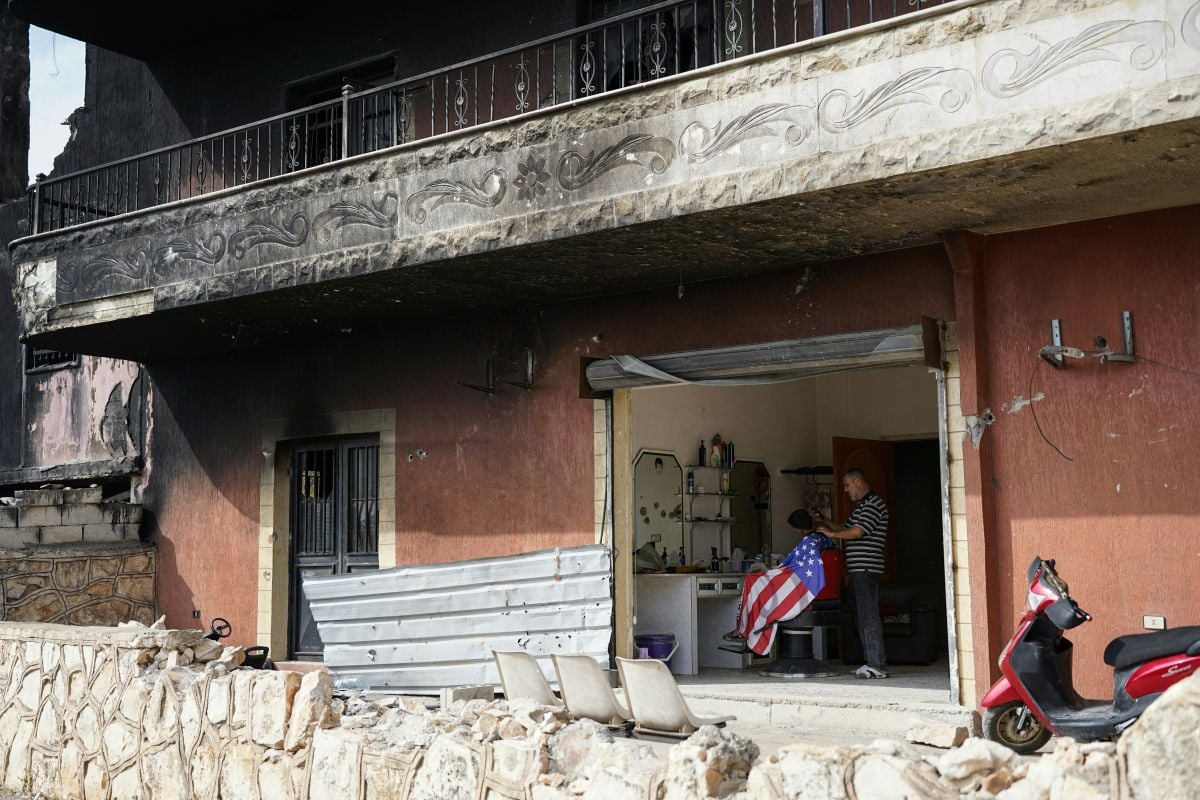
A hairdresser gives a boy a haircut with a barber cape with the colors of the US flag at a damaged barber shop in the southern Lebanese village of Zawtar Gharbieh on Oct. 14, 2026. (Credit: Ammar Ammar / AFP)







As tensions mount in Lebanon and rhetoric intensifies between Hezbollah and its detractors, led by Prime Minister Nawaf Salam, the discovery of a deep pit in a wooded area near Zaatriyeh, a predominantly Shiite neighborhood in Fanar, north of Beirut, has sparked a wave of reactions. Hezbollah has once again come under fire from its opponents, although the purpose of the structure remains unclear. The Lebanese Army has deployed to the site to investigate.
The discovery comes as two Hezbollah MPs spoke out Monday morning in response to a post Salam published on X on Sunday. In it, he called for the investigation into explosives seized from a truck at Dahr al-Baidar — which Hezbollah has claimed belonged to the group — to be expanded. Salam also reiterated that the decision on war and peace must remain "in the hands of the state."
His remarks drew a sharp response from Hezbollah. Mohammad Raad, head of the party’s parliamentary bloc, condemned what he called submission to foreign “dictates” (referring to the United States and Israel) and warned that such positions “lead the country and its citizens to ruin.” Fellow MP Ibrahim Mussawi, meanwhile, called on officials facing foreign pressure to resign and warned that an “imminent explosion” could follow if authorities continued to “put pressure” on Hezbollah’s supporters in the streets.
Why it matters
The standoff between Hezbollah and the state is intensifying as Washington presses Beirut to disarm the group, which has categorically rejected the demand. Several incidents in recent days have further inflamed tensions and are seen by some as a test of the state’s willingness to take a tougher stance toward Hezbollah.
This is unfolding as negotiations between Beirut and Tel Aviv are expected to resume soon in Tampa, Florida, under U.S. mediation. The talks are reportedly contingent on a U.S. and Israeli demand that the Lebanese Army coordinate directly with its Israeli counterpart on the ground.
Pressure on the Lebanese authorities is mounting as the wider region remains on edge. Israeli Prime Minister Benjamin Netanyahu could launch attacks on Lebanon and Iran before Israel’s Oct. 27 parliamentary elections in an effort to boost his electoral prospects. Netanyahu said Monday that Israel has “the ability to strike” its enemies at any time.

Diplomatic visits to Lebanon are also increasing, as international and regional actors seek to prevent a new escalation, ease tensions and avert a “security vacuum” in southern Lebanon, where Israel continues to occupy territory. The United Nations Interim Force in Lebanon (UNIFIL) is scheduled to withdraw in December after its mandate was not renewed.
Following visits by the Qatari prime minister on Friday and the French foreign minister on Sunday, Arab League Secretary-General Nabil Fahmy arrived in Beirut. After meeting President Joseph Aoun, Fahmy said direct negotiations with Israel enjoyed “full Arab support” and that political and diplomatic contacts concerning Lebanon would “intensify.” He also announced plans to visit southern Lebanon, parts of which remain occupied by Israel and where Israeli forces continue to carry out attacks. On Monday morning, Israeli forces conducted a raid and searches of homes in Kfar Shuba, in the Hasbaya district.

- After violence over the weekend on the sidelines of large-scale demonstrations, French President Emmanuel Macron refused to accept the resignation of Interior Minister Laurent Nuñez and asked him to introduce a new crowd-control doctrine targeting “rioters,” in an attempt to contain the political crisis following chaotic scenes in several cities on Saturday. Macron is also set to begin a tour of Gulf countries on Monday.
- The World Food Programme (WFP) said it would have to scale back its humanitarian operations in the Gaza Strip because of a lack of funding, reducing the number of people it assists each month by 500,000. The agency urged the international community not to “look away” from the enclave, devastated by three years of war.
- Russian Foreign Minister Sergey Lavrov is expected in Iran for his first visit to the country since the war in the Middle East broke out in late February, following Israeli-U.S. airstrikes. Moscow is seeking to play a mediating role. Lavrov, who is due to meet Iranian Foreign Minister Abbas Araghchi in Tehran, said Sunday that Russia’s efforts “aim to prevent the return of a large-scale war” amid stalled talks between Tehran and Washington.
- Israeli police announced the arrest of 10 people suspected of involvement in attacks by settlers against an American photographer and a French mayor visiting the occupied West Bank with a convoy of European diplomats.